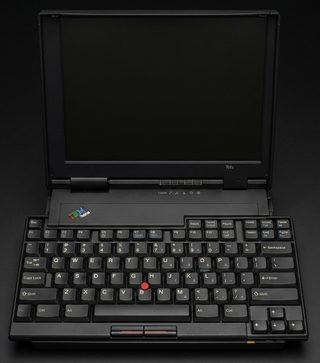
IBM portables & ThinkPads · 1991–1999
The Black Box Era
Service references for early IBM portables and ThinkPads, transcribed from IBM’s own maintenance manuals. They run from the 1991 PS/2 L40 SX and the original ThinkPad 700C of 1992 to the ThinkPad 770 at the end of the decade.
Find your machine, work through its checkouts and parts lists, and keep the original manual close by. Made for people who collect, repair and enjoy these little black boxes.
Find your machine
Each reference covers one IBM machine type (MT), the four-digit type number on the machine’s identification label, and usually several models.
All 21 machine references are listed below. Use the family links above or your browser’s Find command to jump to one.
Pre-ThinkPad IBM Portables
-
IBM PS/2 L40 SX
1991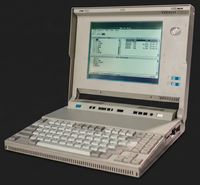
MT 8543
IBM’s first PS/2 laptop: a 20 MHz 386SX with a 10-inch monochrome VGA screen, weighing under 8 lb.
-
IBM PS/2 CL57 SX
1991MT 8554
A 20 MHz 386SX laptop with a 10.4-inch active-matrix colour screen and a built-in trackball.
-
IBM PS/2 Note N33 SX & N51 SX
1991–92
MT 8533 / 8551
Slim PS/2 notebooks with 9.5-inch monochrome screens: the 386SX-based N33 SX and the N51 SX and N51 SLC.
ThinkPad Laptops
-
ThinkPad 700 / 720
1992–93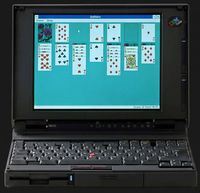
MT 9552
The first ThinkPads: the 700 and 700C with a 25 MHz 486SLC, followed by the 50 MHz 720 and 720C.
-
ThinkPad 300
1992MT 2615
A 25 MHz 386SL notebook with a 9.5-inch monochrome screen and Ethernet built into the system board.
-
ThinkPad 500
1993MT 2603
A subnotebook under 4 lb with a 50 MHz 486SLC2 and a 7.4-inch monochrome screen.
-
ThinkPad 750 / 755 and 370C
1993–95MT 9545
IBM’s premium 486 and Pentium notebooks, from the 750 to the CD-ROM 755CD and Pentium 755CX, plus the 370C.
-
ThinkPad 510Cs
1994MT 2604
The colour successor to the ThinkPad 500: a 50 MHz 486BL2 with a 7.7-inch dual-scan screen.
-
ThinkPad 355
1994MT 2619
A 33 MHz 486SX notebook sold through retailers, with a monochrome, dual-scan or 8.4-inch TFT colour screen.
-
ThinkPad 360
1994–95MT 2620
486SX and 486DX2 notebooks with monochrome or colour screens, plus the pen-enabled 360P and 360PE.
-
ThinkPad 340 / 345
1994–95MT 2610
Budget notebooks: the 486SLC2 340 and 340CSE, and the 486DX4 345C and 345CS sold outside the US.
-
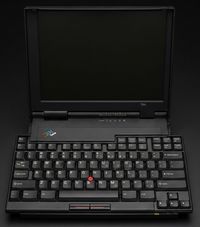
MT 2630
The 701C and 701CS: a 10.4-inch 486 subnotebook whose TrackWrite keyboard expands to full size as the lid opens.
-
ThinkPad 365
1995–97MT 2625
IBM’s value line, from the 486 365C and 365CS to the Pentium 365X; D models add a CD-ROM drive.
-
ThinkPad 760 / 765
1995–97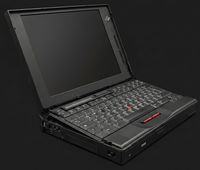
MT 9546 / 9547
High-end Pentium notebooks with screens up to 13.3 inches and an automatic tilt-up keyboard.
-
ThinkPad 560
1996–98MT 2640
A slim Pentium notebook, 1.2 inches thick and about 4 lb, with an external diskette drive: the 560, 560E, 560X and 560Z.
-
ThinkPad 380 / 385
1997–98MT 2635
Pentium notebooks with a built-in diskette drive and, on most models, a CD-ROM, up to the Pentium II 380Z.
-
ThinkPad 770
1997–99MT 9548 / 9549
IBM’s high-end multimedia notebook: Pentium MMX to Pentium II, 13.3- to 14.1-inch screens up to 1280 × 1024, and CD-ROM or DVD-ROM drives.
-
ThinkPad 390 / 390E
1998–99MT 2626
Mainstream Pentium MMX and Pentium II notebooks with 12.1- to 14.1-inch screens and a built-in diskette drive and CD-ROM.
-
ThinkPad 240
1999MT 2609
A 10.4-inch Celeron subnotebook weighing just under 3 lb, with a 95%-size keyboard.
ThinkPad Pen Tablets
-
ThinkPad 710T
1993MT 2523
A slate pen tablet: a 25 MHz 486SLC, a 9.5-inch transflective monochrome screen and hard-disk or solid-state storage.
-
ThinkPad 730T / 730TE
1994–95MT 2524
Pen tablets for mobile field workers: the 33 MHz 486SX 730T and the faster 486DX4 730TE.
No machines match .
Try a model number such as 755, or a four-digit machine type such as 2630. The document library also covers a few machines without a reference page.
Beyond the parts list
-
Document library
55 original manuals, specification books, user guides, brochures and advertisements as PDFs.
-
Experimental 3D models
Watch the 701C’s keyboard unfold and the 760’s tilt up, and step through an approximate disassembly.
-
About this archive
Where the references come from, what to double-check and how to send a correction.